

When it comes to dental billing, distinctions between dental procedures aren’t always clear-cut. Procedures can differ but involve the same problem. For example, routine dental cleaning, scaling, and root planing are all distinct dental services. However, they all involve removing plaque and tartar. Despite treating the same problem, they require different billing codes, potentially leading to a higher error rate during the filing process.
And among the many administrative tasks dental practices can’t afford to overlook, billing is arguably one of the most critical because a practice’s revenue depends on it. As a matter of fact, the American Dental Association’s Q4 2025 Economic Outlook and Emerging Issues in Dentistry reported that 55.3% of dentists surveyed identified insurance-related issues, including low reimbursements and claim denials, among their biggest challenges heading into 2026.
For this reason, dental front desk staff and billing teams, whether in-person or dental virtual assistants (VAs), must know these distinctions because even when a procedure has been performed correctly, using an inaccurate code can lead to claim denials or requests for additional documentation. But with hundreds of codes to choose from, knowing which ones to use and when can be challenging.
So, what is a CDT code, and which ones should your team be familiar with? More importantly, what are the common coding mistakes that could affect your practice’s insurance claims?
What Are CDT Codes?
The Code on Dental Procedures and Nomenclature, often referred to as CDT codes, is a standardized set of codes for dental procedures that is developed and maintained by the American Dental Association (ADA) and published in Current Dental Terminology (CDT). From a practical standpoint, CDT codes let you and your team identify the specific procedures you perform, improving the alignment between your practice and your patients’ insurance payers.
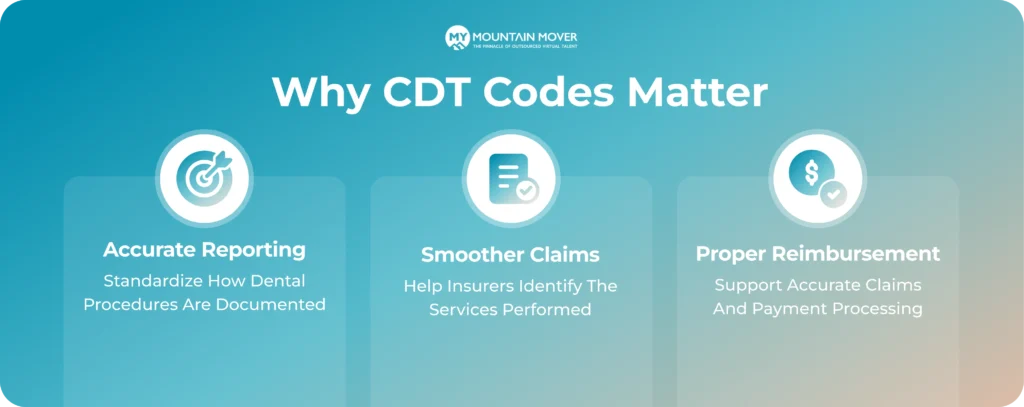
As far as format goes, CDT codes start with the letter D and are followed by four numbers. While the format may appear straightforward at first glance, each code’s specific definition also determines when it should be used, making accuracy all the more critical. However, choosing the correct code doesn’t automatically guarantee payment because, depending on the payer, the procedure itself must also meet the patient’s coverage requirements.
Do CDT Codes Change?
Yes. With annual updates, you and your team should consistently stay on top of these changes, whether they involve definitions, the addition or removal of certain codes, or reporting requirements. For example, the 2026 CDT update introduced 60 changes that took effect on January 1, 2026. That means if your practice is still using a 2025 CDT code list, you have a higher risk of submitting claims with inaccurate codes.
The 13 Categories of Service in CDT Codes
There are 13 categories of service that CDT codes are organized into, all of which correspond to a specific area of dental care. Some of these involve procedures that general dental practices often perform, while others apply to a specialized set of treatments, such as those for orthodontics and oral surgery.
| Category | Procedures Included |
| Diagnostic | Oral evaluations, radiographs, and other diagnostic procedures |
| Preventive | Dental cleanings, fluoride treatments, and sealants |
| Restorative | Fillings, crowns, and procedures for repairing damaged teeth |
| Endodontics | Root canal treatments and other procedures involving dental pulp |
| Periodontics | Scaling and root planing, periodontal maintenance, and gum treatments |
| Prosthodontics, Removable | Complete dentures, partial dentures, and related procedures |
| Maxillofacial Prosthetics | Prosthetic appliances used to restore oral and facial structures |
| Implant Services | Dental implant placement, maintenance, and related procedures |
| Prosthodontics, Fixed | Dental bridges and other fixed prostheses |
| Oral and Maxillofacial Surgery | Tooth extractions, biopsies, and other surgical procedures |
| Orthodontics | Braces, orthodontic appliances, and related treatments |
| Adjunctive General Services | Anesthesia, emergency treatments, and other supporting procedures |
| Sleep Related Breathing Disorders and Airway Management Services | Oral appliances and services related to sleep-related breathing disorders |
By understanding how CDT codes are organized, you and your team can find and choose codes more accurately and efficiently.
Most-Used CDT Codes: A Dental Coding Cheat Sheet
While there are hundreds of CDT codes to choose from, there are ones you may encounter more often than others, especially in general dental clinics where routine examinations, cleanings, fillings, and extractions account for many of the services provided. For in-person or virtual dental receptionists and billers, familiarity with these codes, using a dental codes cheat sheet, can be useful to make the check-in, review, and check-out processes more efficient.
| CDT Code | Category | Procedure Description |
| D0120 | Diagnostic | Periodic oral evaluation for an established patient |
| D0150 | Comprehensive oral evaluation for a new or established patient | |
| D0180 | Comprehensive periodontal evaluation | |
| D0210 | Complete intraoral radiographic series | |
| D1110 | Preventive | Adult dental prophylaxis |
| D1120 | Child dental prophylaxis | |
| D1206 | Topical fluoride varnish application | |
| D1208 | Topical fluoride application, excluding varnish | |
| D2740 | Restorative | Porcelain or ceramic crown |
| D4341 | Periodontics | Scaling and root planing, four or more teeth per quadrant |
| D4342 | Scaling and root planing, one to three teeth per quadrant | |
| D4910 | Periodontal maintenance | |
| D7140 | Oral and Maxillofacial Surgery | Extraction of an erupted tooth or exposed root |
| D7210 | Extraction requiring bone removal and/or tooth sectioning | |
| D9110 | Adjunctive General Services | Palliative treatment of dental pain |
Note: These descriptions have been simplified for reference. Consult the current ADA CDT manual for complete definitions and reporting requirements.
Do note, however, that this table simply serves as a quick reference, not a complete list of dental codes. More importantly, some procedures share similar descriptions with others but have different requirements for reporting. For example, D4341 and D4342 both refer to scaling and root planing. However, the former only applies when four or more teeth are treated within a quadrant, while the latter only covers one to three. That means that the appropriate code will still depend on what was actually performed, and using the wrong code, even within the same category, can lead to claim denials or payment delays.
Common CDT Coding Mistakes That Can Lead to Claim Denials
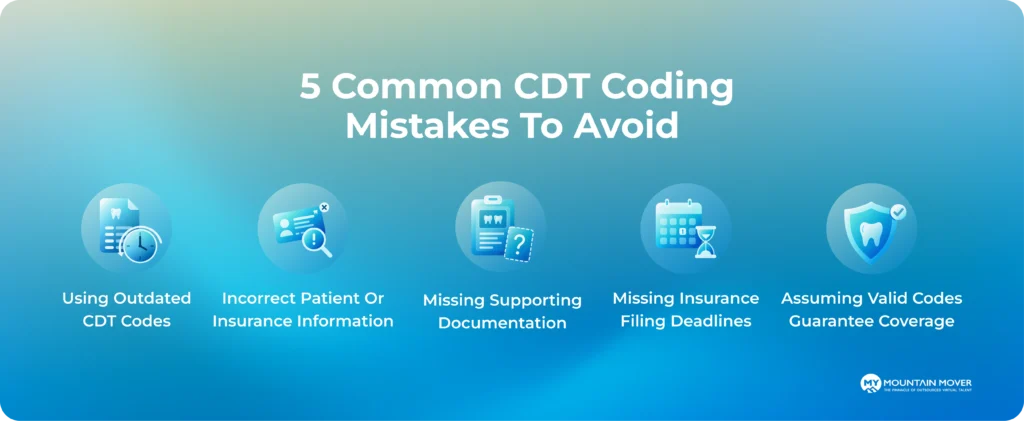
Knowing which dental billing codes correspond to certain procedures is important. However, the following mistakes can still occur when submitting claims.
1. Using Outdated CDT Codes
As previously mentioned, CDT codes are updated annually by the ADA. However, staying on top of these changes requires an active effort because not every dental practice immediately updates its billing software or reference materials.
By using an outdated CDT code list as a billing reference, especially when it contains a deleted code, the claims you submit may not be processed appropriately. This can lead to claim denials, delayed payments, or incorrect reimbursements. For these reasons, you should review your saved procedure templates and coding references whenever a new CDT edition is released.
2. Submitting Claims With Incorrect Patient or Insurance Information
Your billers could be using the correct CDT code and still have a claim rejected if the patient’s personal or insurance information is inaccurate. It doesn’t even need to be a substantial error. Something as simple as entering the wrong member ID or submitting a claim under an inactive policy can keep the insurance company from processing it.
This mistake underscores the importance of properly verifying patients’ insurance information before they even arrive for their appointments, especially when they have recently updated their coverage. Otherwise, your billing team may have to go back, correct, and resubmit claims that could have been processed without additional intervention.
3. Submitting Claims Without Supporting Documentation
Not every dental insurance claim can be processed by simply using the correct CDT code. Depending on the treatment the patient received and the requirements established by the insurance company, additional documents may be necessary. For example, some claims may require periodontal charting or a clinical narrative to justify the necessity of the procedure.
If these documents aren’t included, the insurance company may request additional information before processing the claim. While this doesn’t mean that your practice used the wrong code, it can still delay reimbursement and make resubmission necessary, which can result in additional administrative costs.
4. Missing Insurance Filing Deadlines
More often than not, insurance companies establish deadlines for claim submissions. However, the exact timeframe depends on the payer and/or the patient’s plan. If you miss a claim submission deadline, the insurance company may deny the claim for reimbursement even if you use the appropriate codes or submit the patient’s information accurately.
With multiple claims needing to be processed, your billing team could easily overlook some of them, especially if they already have a backlog to catch up on. To make sure that claims are submitted not just accurately but also promptly, your practice should establish a system that keeps track of pending claims and prioritizes those that are nearing their filing deadlines.
5. Assuming a Valid CDT Code Guarantees Insurance Coverage
One thing worth remembering about CDT codes is that they were designed to identify dental procedures, not to guarantee reimbursement. Insurance companies have their own criteria for determining whether a procedure is covered, including frequency limitations, waiting periods, and exclusions for certain treatments. These requirements can also vary between patients, even when they’re insured by the same company.
For this reason, your front desk team shouldn’t rely on the CDT code alone when discussing treatment costs with patients. Instead, they should verify the patient’s benefits beforehand so that you can provide patients with a more accurate estimate of what insurance may pay and how much the patient might need to cover out of pocket.
How Can Dental Practices Reduce CDT Coding Errors?
While knowing the common coding mistakes can help your team identify potential problems, preventing them consistently requires coordination between the clinical staff and the employees responsible for preparing insurance claims.
After all, the billing team relies on the dentist’s treatment documentation to determine which procedure codes should be reported. If the records are incomplete or unclear, staff members may have difficulty preparing an accurate claim.
Keep Your Dental Coding References Updated
One of the first things your practice should do is make sure that everyone responsible for dental billing has access to the current CDT code set. If your practice maintains an internal dental codes list or uses saved procedure templates, these should be reviewed whenever the ADA releases a new edition. This is particularly important for codes that have recently been revised or deleted.
A dental coding cheat sheet can also be useful for frequently performed procedures, although staff members should still consult the official definitions when they encounter unfamiliar codes.
Review Claims Before Submission
Before submitting a claim, billing staff should confirm that the selected code matches the treatment documentation and that all required information has been included. For instance, a claim involving a restorative procedure may need the appropriate tooth and surface information, while certain periodontal treatments may require additional clinical records.
If the documentation doesn’t clearly support the selected code, the billing team should seek clarification from the treating dentist rather than making assumptions. Doing so can help prevent avoidable corrections and resubmissions later.
Consider Delegating Routine Billing Responsibilities
For dental practices handling a growing number of patients, reviewing claims and following up with insurance companies can become time-consuming, especially when the same employees are responsible for answering calls, managing appointments, and verifying insurance benefits.
One option worth considering is hiring a dental billing virtual assistant who can help prepare claims, check for missing information, post payments, and follow up on outstanding reimbursements.
Practices may also benefit from dental virtual assistants who can manage other administrative responsibilities, including patient calls, appointment scheduling, and insurance verification. By delegating these tasks, your existing staff can devote more attention to patients and responsibilities that require their physical presence.
However, coding concerns that require clinical judgment should still be referred to the treating dentist.
Make Managing Your Dental Billing Easier
Dental billing involves more than assigning CDT codes to the procedures performed by your dentists. Your team also needs to make sure that claims contain accurate patient information, appropriate documentation, and the details required by the insurance company.
For practices handling a growing patient volume, keeping up with these responsibilities can become challenging, particularly when front desk staff members are also managing appointments, calls, and other administrative tasks.
My Mountain Mover provides healthcare-trained virtual assistants who can help dental practices with insurance verification, claims preparation, payment posting, and other administrative responsibilities. Apart from its recruitment and screening process, the company also offers structured onboarding and ongoing client support to help its VAs become familiar with the workflows of the practices they serve.
If your practice needs additional support with dental billing or front desk operations, book a 10-minute discovery call with My Mountain Mover to discuss which responsibilities you can delegate.

Frequently Asked Questions
How many CDT codes are there?
There are hundreds of CDT codes created and maintained by ADA. However, the exact figure changes every time the organization updates it to add new codes and revise or remove existing ones.
How often do CDT codes change?
CDT codes are updated by ADA every year, with each new edition taking effect on January 1. However, these updates don’t mean that every code is being changed. Some remain as they are, others get updated, and a few are added.
What are the most common CDT codes?
Some commonly used CDT codes include D0120 for periodic oral evaluations, D1110 for adult prophylaxis, and D2740 for porcelain or ceramic crowns. However, the codes your practice uses most frequently will depend on the dental services you provide.