

“Virtual receptionist” can mean a trained person answering calls remotely or an AI system answering them automatically, and the two handle patient calls differently. For calls that need judgment, a human virtual medical receptionist can assess context, follow your escalation protocol, and route the call appropriately. An AI receptionist can take on rule-based work like routine scheduling when it’s connected to your systems. The right fit depends on your call mix, HIPAA-compliant safeguards, data security, and system integration.
At a Glance: Human vs. AI
No single option wins every call type. AI receptionists tend to fit routine, rule-based requests, while human virtual receptionists are ideal for calls that need judgment. A hybrid model assigns each call type to whichever fits, with a person reviewing the AI’s work where a practice wants that oversight.
This table compares all three approaches side by side:
| Call Type | Human Virtual Receptionist | AI Receptionist | Hybrid |
|---|---|---|---|
| Routine scheduling | Books, confirms, and reschedules within your systems | Confirms and reschedules rule-based requests | AI takes the routine volume, and a person handles the rest |
| Scheduling exceptions and complex conversations | Manages exceptions, insurance questions, and distressed callers | Hands off conversations it can’t resolve | AI flags the exception, and a person steps in |
| Escalation and handoff | Routes urgent messages under your protocol | Needs a defined handoff path to a person | Both follow one documented protocol |
| Downtime and reliability | Scheduled time off, consistent presence otherwise | Depends on uptime and system integrations | Each can cover gaps in the other |
| Oversight | Signed BAA, compliance officer, ongoing training | Needs a BAA and human review of its output | Oversight applies across both channels |
How Do Human and AI Receptionists Compare Across Daily Patient Calls?
Five areas of daily call handling show where a human virtual receptionist and an AI receptionist each work well, and where one needs the other to step in.
1. Routine Scheduling
Both options can manage routine scheduling. An AI receptionist connected to your scheduling system can confirm, book, and reschedule straightforward appointments without a person on the line. A virtual medical receptionist handles the same requests inside your existing systems, with the added judgment to catch what the tool might miss.
2. Scheduling Exceptions and Complex Conversations
AI receptionist scheduling limitations usually trace back to integration and rule setup, since the tool is only as capable as the system and logic behind it. Outside those rules, most tools route the call onward rather than resolve it. On the human side, a virtual medical receptionist’s responsibilities include managing exceptions, insurance questions, and distressed callers, though clinical decisions always remain with clinical staff.
3. Escalation and Human Handoff for Patient Calls
The success of a handoff depends on who owns the outcome on the other end, which is why a strong process includes a documented protocol, shared context, and a named person who receives the call. Either option should route urgent or sensitive calls to staff in accordance with the practice’s escalation protocol.
A virtual medical receptionist routes urgent messages and separates routine inquiries from those needing an immediate response. Standardized tools and documented processes reduce miscommunication during patient handoffs, a hospital-setting principle that applies just as well at the front desk.
4. Downtime and Reliability
Downtime varies by who’s answering. A human virtual receptionist has scheduled time off, so continuity depends on backup coverage. Uptime is what keeps an AI receptionist running, and an outage, integration failure, or change to your practice management system can interrupt it without warning.
Service level agreements can address system availability and data recovery, so it’s worth asking any vendor what theirs covers before you commit.
5. Oversight and HIPAA Compliance
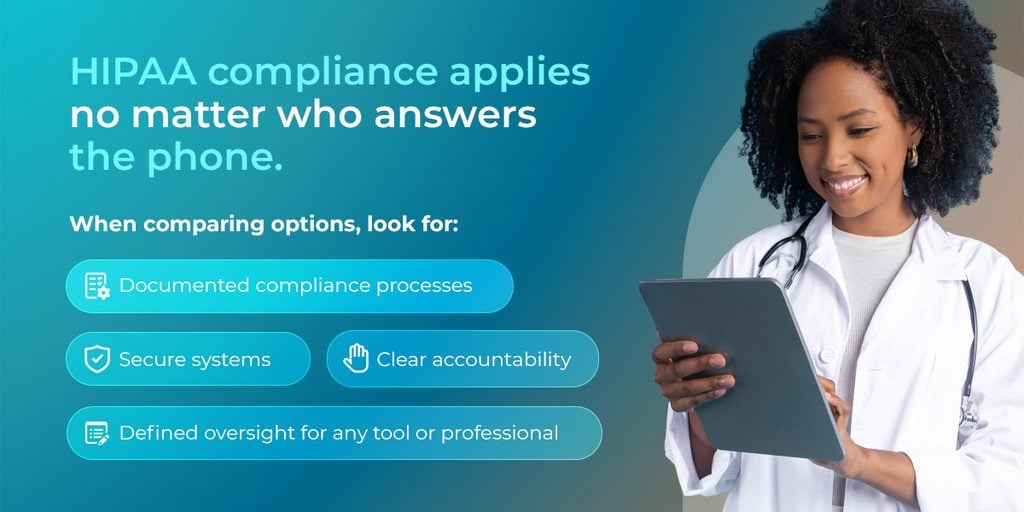
HIPAA compliance applies no matter who answers the phone. When comparing options, look for documented compliance processes, secure systems, clear accountability, and defined oversight for any tool or professional that may handle protected health information.
A practice using an AI tool that touches protected health information generally needs a business associate agreement (BAA) with that vendor, since federal guidance treats a scheduling chatbot as a business associate once it handles that data. Additionally, outbound calls using an AI-generated voice also require prior express consent under a 2024 Federal Communications Commission ruling.
When Does a Human Virtual Receptionist Fit Your Practice?
A few recurring patterns in your call volume usually signal when a human virtual receptionist fits your practice:
- Frequent scheduling exceptions: Your calls regularly involve rescheduling conflicts, insurance questions, or requests that don’t fit a standard script.
- A patient base that needs reassurance: Sensitive or emotional calls come up often enough that a calm, judgment-based response matters.
- A need for consistency: One dedicated professional who learns your workflows outperforms a rotating cast of part-time help.
- Calls that need judgment on routing: Deciding what’s urgent takes judgment that rules alone can’t capture.
A vetted, full-time virtual medical receptionist can focus on your practice’s workflows, scheduling rules, communication preferences, and escalation protocols in a way part-time or shared help often can’t. When support is split across clients, it can limit continuity and make it harder for that person to fully integrate into your team.
When Does an AI Receptionist Fit Your Practice?
Three things typically determine whether an AI receptionist fits your practice: high routine call volume, a scheduling system the tool can connect to, and clear rules for handing a call to a person. Pew Research Center data found that 29% of Americans are open to AI handling appointment scheduling on its own, while a larger share prefer human final review.
What Does a Hybrid Receptionist Model Look Like?
A hybrid model splits calls by type, sending routine, rules-based requests to a practice’s own AI tool while a human virtual receptionist takes exceptions, sensitive callers, and anything needing escalation. Researchers studying voice agents in healthcare describe them as a potential extension of the care team, though implementation challenges remain. A practice can run AI tools alongside remote staff most effectively when the practice itself owns the AI tool, and the receptionist stays focused on their own calls.
Frequently Asked Questions
A few questions come up often when practices start comparing their options.
Why does full-time receptionist support matter?
Full-time support gives a virtual medical receptionist more room to learn your workflows, patient communication preferences, scheduling rules, and escalation protocol. That consistency can make the role more valuable than part-time or shared support that has to balance competing priorities across multiple practices.
Can an AI receptionist handle scheduling exceptions and complex patient requests?
It depends on the specific tool and how it’s configured. When a request falls outside its rules, most AI receptionists hand it off rather than guess, which is why a clear path to a person still matters for anything unusual.
Can a medical practice use AI tools alongside a human virtual receptionist?
Yes. Most practices that combine the two need a BAA with any AI vendor that handles patient data, a way to secure patient consent where required, and a single named person who owns calls that are handed off between the two.
Discover Your Ideal Receptionist Model With My Mountain Mover
The right receptionist model hinges on your call volume, your patients’ needs, and the level of judgment each call requires. My Mountain Mover provides vetted, foundationally trained, full-time, HIPAA-compliant virtual medical receptionists for established, U.S.-based healthcare practices. With guided onboarding and dedicated support, your receptionist can integrate into your workflows, support front-desk continuity, and help reduce overhead.
Get started with a free consultation or call (909) 769-0692 to find the fit for your calls.