


Electronic health records (EHRs) are now a standard part of running a U.S. medical practice. According to the Office of the National Coordinator for Health Information Technology (ONC), 95% of U.S. office-based physicians used some type of electronic health record in 2024. However, what’s interesting is that ‘EHR’ isn’t the only term used for these systems.
Other healthcare professionals use ‘EMR’ or electronic medical records when referring to digitized patient information. Because they are closely related and are only differentiated by one word, it’s easy to think that EHR and EMR mean the same thing.
But that isn’t always the case because there is an important difference between them.
What Is an EMR?
An electronic medical record (EMR) is a digital version of the patient charts traditionally kept on paper, detailing information such as diagnoses, medications, treatment history, test results, clinical notes, and other information collected by your practice.
Aside from making patient information easier to retrieve, an EMR can help you track health data over time. For example, you can use it to monitor changes in a patient’s blood pressure or identify patients who are due for preventive screenings.
In most cases, an EMR is primarily used exclusively within your practice.
What Is an EHR?
An electronic health record (EHR) contains much of the same patient information as an EMR. However, EHRs are designed to make relevant health information available across different healthcare organizations.
Not all patients require healthcare from just one service provider. Some patients may require primary care from your practice but specialized intervention from a different provider for a specific condition
With an EHR, all of your patients’ providers can work from the same record, reducing duplicate tests, cutting down on mailed charts, and helping ensure everyone is making decisions based on the same information.
EMR Vs. EHR: What’s the Difference?
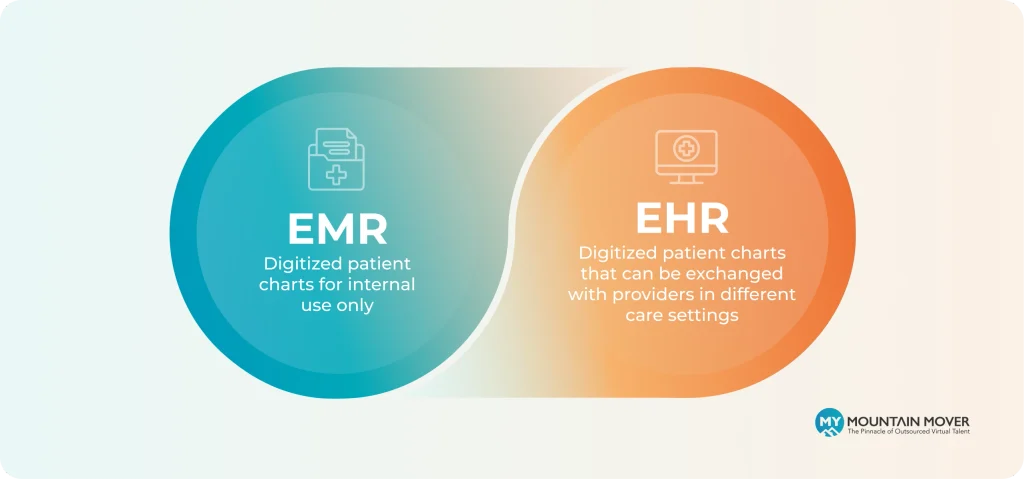
While both EMR and EHR serve the same purpose of detailing patient information digitally, what sets them both apart is their scope.
This doesn’t necessarily make one better than the other. The distinction mainly describes how far the patient’s information is intended to go.
Why Are EMR and EHR Used Interchangeably?
Despite their traditional definitions, EMR and EHR are often used interchangeably. Even ONC acknowledges that the terms are commonly used to describe the same technology.
Modern systems have also made the distinction less clear. A product referred to as an EMR may offer information-sharing capabilities traditionally associated with an EHR, so the name alone doesn’t always tell you what a particular system can do.
Because of this, looking at the system’s actual capabilities is more useful when you’re comparing your options.
Should Your Practice Use an EMR or EHR?
Your choice should ultimately depend on how your practice works and what you need from the system. If your providers regularly coordinate with hospitals, laboratories, specialists, or other healthcare organizations, the ability to exchange patient information may be particularly important.
You should also consider whether the system works with your existing technology, how easy it is for your staff to use, and whether it provides the security and access controls your practice needs.
Cost is another consideration. Apart from the software itself, implementation, training, support, and integrations can add to your total expenses.
Most importantly, don’t choose a system based solely on whether it’s called an EMR or EHR. Look at the features it offers and whether they fit your existing workflow.
Who Can Help Manage EMR and EHR Tasks?
Regardless of the system you use, your staff still needs to manage the administrative work that happens inside it.
Depending on their role, staff members may use your EMR or EHR to update patient information, manage appointments, prepare records, and complete other administrative tasks. Many of these responsibilities can also be handled remotely by a medical virtual assistant.
If you’re considering a virtual employee, familiarity with healthcare workflows and electronic record systems can be valuable. Their access should also match the responsibilities you’ve assigned to them and the information they need to perform their job.
Virtual assistant companies like My Mountain Mover can help you find healthcare-trained professionals with experience working in EHR and EMR systems like the one your practice already uses.
Make The Most Out of Your Electronic Records
Your EMR or EHR can make patient information easier to manage, but your practice still needs people to handle the administrative work behind it.
My Mountain Mover can help you find a healthcare-trained virtual assistant who can work within your existing systems and support your practice’s administrative responsibilities.
Schedule a free consultation today to find your ideal VA.

Frequently Asked Questions
Can You Switch From One EHR or EMR System to Another?
Yes. However, you’ll need to plan how patient records will be transferred and how the new system will work with your existing tools. Your staff may also need training before making the switch.
What Happens to Patient Records if You Change EHR Systems?
Your practice still needs to retain required patient records after switching systems. Before making the change, determine how existing records will be transferred, stored, and accessed afterward.
What Happens to Your EHR if You Close or Sell Your Medical Practice?
Your responsibility for patient records doesn’t automatically end when you close or sell your practice. You’ll still need to follow applicable requirements for retaining, transferring, and giving patients access to their records.