


Medical practice managers face surging administrative workloads as regulatory complexity intensifies, staffing Medical practice managers face surging administrative workloads as regulatory complexity intensifies, staffing costs escalate, and burnout threatens workforce stability. In this healthcare environment, a skilled medical receptionist is a strategic asset, bridging patient engagement with clinical efficiency.
Front-desk hiring decisions can determine whether a practice operates with precision or struggles under administrative strain. This guide provides a comprehensive description of the medical receptionist role, including core responsibilities, qualifications, and business impact, showing what practices should look for in a receptionist and how to find the right fit.
What Do Medical Receptionists Do?
Medical receptionists maintain administrative order and efficiency at the practices they serve, from initial patient engagement and appointment management to overseeing the entire revenue cycle.
Patient Engagement
A medical receptionist’s job description includes patient-facing responsibilities that directly influence care quality and satisfaction:
- Patient greeting and reception: They serve as the initial point of contact, establishing a welcoming atmosphere that sets the tone for the entire visit.
- Check-in and checkout management: Medical receptionists process patient arrivals and departures, verify appointments, and confirm information accuracy.
- Patient guidance: Receptionists provide essential information on insurance procedures, appointment protocols, and practice policies, liaising between patients and clinical staff.
Administrative Management
A medical receptionist’s administrative duties are essential to healthcare delivery:
- Appointment scheduling: They coordinate calendars across providers, manage rescheduling and cancellations, and optimize clinic capacity using scheduling software.
- Communication management: Modern receptionists must handle multi-line phone systems, triage incoming emails and calls, take accurate messages, and direct inquiries to appropriate staff.
- Medical records administration: They create, update, and maintain patient records in both electronic and physical formats, ensuring HIPAA compliance through meticulous documentation.
- Interdepartmental coordination: Medical receptionists facilitate communication between physicians, nurses, and specialists to synchronize patient care workflows.
Financial Processing
Medical receptionists handle essential front-end revenue cycle functions that protect practice cash flow:
- Insurance verification: Confirming patient eligibility and benefits prior to appointments reduces claim denials and surprise bills.
- Payment collection: Receptionists process copayments, deductibles, and outstanding balances, providing patients with clear explanations of charges.
- Billing coordination: They ensure accurate capture of visit details and codes, supporting downstream billing operations whether handled in-house or by external partners.
What Qualifications Are Required for a Medical Receptionist’s Job?
Identifying qualified applicants for medical receptionist roles depends on understanding the skills that set exceptional candidates apart. Important qualifications include technical proficiencies, interpersonal skills, and formal credentials.
Hard Skills
There are measurable, trainable abilities that candidates should have before entering a medical receptionist role, or they must show that they can acquire these skills quickly during onboarding:
- EHR system proficiency: Candidates must demonstrate fluency in patient registration, scheduling, record retrieval, and documentation within Electronic Health Record (EHR) platforms, with adaptability across multiple systems.
- Medical terminology knowledge: A strong command of anatomical terms, common diagnoses, and clinical procedures ensures accurate communication with healthcare teams and precise documentation in patient records.
- Insurance and billing competence: Understanding insurance verification protocols, claims processing, and basic medical coding is essential for managing front-end revenue cycle functions effectively.
- Office software expertise: Advanced proficiency in standard business applications enables efficient document creation, data management, and professional correspondence.
- Data entry accuracy: High-speed input capabilities combined with meticulous attention to detail minimize errors in patient information and financial records.
- Telecommunications management: Expert handling of multi-line phone systems facilitates efficient call routing, message management, and patient communication.
Soft Skills
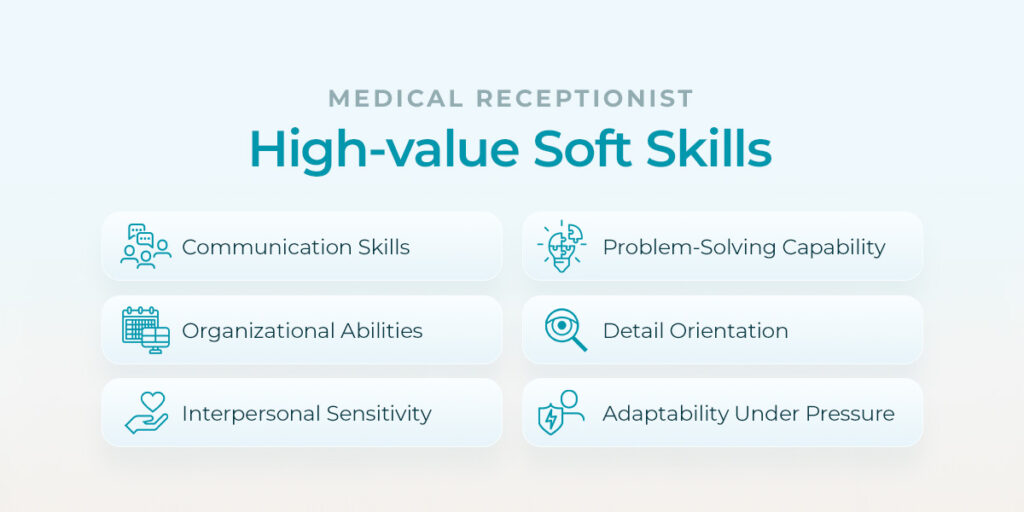
Interpersonal and organizational capabilities are harder to teach than technical skills, making it critical to assess these high-value soft skills during interviews with candidates for patient-facing roles:
- Communication skills: Clear, empathetic verbal and written communication enables effective interactions with patients, clinical staff, and external parties.
- Organizational abilities: Managing concurrent tasks, appointments, and records while maintaining meticulous documentation requires strong coordination abilities.
- Interpersonal sensitivity: Compassion, patience, and discretion are critical for building trust and fostering positive experiences, especially with anxious or distressed patients.
- Problem-solving capability: Efficient receptionists proactively identify and resolve administrative and patient-related issues, preventing operational disruptions.
- Detail orientation: Precision in data entry, record maintenance, and financial transactions minimizes costly errors that could impact patient care or billing.
- Adaptability under pressure: Long-term performance as a medical practice receptionist depends on maintaining composure while juggling responsibilities in a fast-paced environment.
Education and Certifications
Formal credentials provide objective benchmarks for evaluating candidate readiness and commitment to professional healthcare administration standards. Relevant qualifications include:
- Baseline requirement: A high school diploma or GED certificate is the minimum educational qualification for medical receptionist positions.
- Vocational training: Vocational programs, diplomas, certifications, or associate’s degrees in medical office administration can set candidates apart with focused foundational knowledge.
- HIPAA compliance training: Understanding of the safeguards necessary to protect Electronic Protected Health Information is critical for healthcare receptionist roles.
What Is the Business Impact of a Medical Receptionist’s Duties?
Over 25% of healthcare spending is consumed by administrative overhead. Investing in a skilled receptionist mitigates this burden and delivers tangible returns through performance that influences revenue, operational efficiency, and workforce sustainability.
Enhancing the Patient Experience
Initial patient contact — whether by phone, during scheduling, or at check-in — fundamentally shapes the perception of practice quality and care standards. Elite receptionists establish welcoming, efficient experiences through these critical touchpoints, setting the tone for the entire patient relationship. Excellent communication, proactive problem-solving, and patient-centered engagement drive higher satisfaction scores, fostering loyalty and positive referrals. Research shows that receptionist demeanor and communication significantly influence patient satisfaction with healthcare experiences.
Driving Practice Efficiency
Smart scheduling practices balance patient access with provider availability, reducing no-show impact and maximizing billable hours. Strategic scheduling and consistent follow-up reduce costly patient no-shows, while advanced appointment systems can increase attendance rates by 10% monthly and boost capacity utilization by 6%. Accurate billing processes minimize revenue leakage, while streamlined documentation and communication free up clinical staff to focus on revenue-generating patient care.
Alleviating Staff Burnout
EHR-related administrative workload is a major risk factor for physicians facing burnout. A 2024 survey revealed that over 43% of physicians experienced at least one burnout symptom. Competent receptionists shield physicians and nurses from constant interruptions and clerical burdens, letting them focus on rewarding clinical work rather than playing administrative catch-up after hours.
What Is the Best Way to Hire a Medical Receptionist?
Traditional hiring models come with substantial costs and operational constraints. The average cost per new hire approached $4,700 in 2022, not including the ongoing expenses of maintaining in-house staff. The monthly cost of an in-house medical receptionist — including salary, benefits, payroll taxes, workspace, equipment, and HIPAA compliance — typically ranges from $4,000 up to $5,950, totaling $48,000 to $71,400 annually.
On the other hand, virtual medical receptionists are trained in medical terminology, EHR proficiency, and HIPAA compliance. They deliver up to 70% annual labor cost reductions compared to in-house staff. Virtual professionals also offer enhanced scalability, faster deployment, and access to global talent pools. My Mountain Mover can pair your practice with qualified candidates who suit your needs.
Find Your Virtual Medical Receptionist With My Mountain Mover
My Mountain Mover specializes in matching your practice with HIPAA-compliant virtual medical receptionists who integrate seamlessly into your operations. As an award-winning partner in healthcare administrative solutions, we’ve built our reputation on delivering measurable improvements in efficiency, patient satisfaction, and practice profitability.
Eliminate the financial burden and uncertainty of traditional hiring while gaining access to trained, compliance-focused professionals who understand medical terminology, EHR systems, and the operational demands of healthcare practices. Contact us online or call (909) 610-9793 today to discuss your administrative needs.